Orlando’s subtropical climate brings year-round challenges that most homeowners don’t see coming, until water starts pooling where it shouldn’t. Between afternoon thunderstorms, hurricane season, and the steady rain of oak leaves and pine needles, gutters take a beating. Neglected gutters don’t just look bad: they trigger foundation cracks, fascia rot, and landscape erosion that can cost thousands to repair. This guide walks through everything Orlando homeowners need to know: when to clean, how to do it safely, and when it’s smarter to hand the ladder off to someone else.
Table of Contents
ToggleKey Takeaways
- Orlando gutter cleaning is essential due to the subtropical climate’s heavy rainfall, year-round debris, and risk of foundation damage, fascia rot, and mosquito breeding grounds.
- Clean your gutters in late April/early May and late October/early November, plus after any named storm, with additional cleanings for homes under mature trees or with aged roofs.
- DIY gutter cleaning requires proper safety equipment including an extension ladder, standoff stabilizer, work gloves, and a spotter, along with careful technique to avoid pressure washers and overreaching.
- Professional gutter cleaning services are recommended for two-story homes, steep-pitch roofs, or when repairs are needed, typically costing $120–$250 for single-story Orlando homes.
- Inspect gutter pitch (1/4 inch per 10 feet slope), downspout drainage, and fascia condition while cleaning to catch early signs of structural issues before they become costly repairs.
Why Gutter Cleaning Is Critical for Orlando Homes
Orlando sits in USDA Hardiness Zone 9b, which means lush growth and constant organic debris. Live oaks drop leaves sporadically throughout the year, not just in fall. Add Southern pines, palm fronds, and the seed pods from sweetgum trees, and gutters clog faster here than in drier climates.
Clogged gutters cause specific problems:
• Foundation damage: Water overflows and saturates the soil around your slab or crawlspace. Florida’s sandy soil doesn’t drain uniformly, leading to settlement cracks and hydrostatic pressure against block walls.
• Fascia and soffit rot: Constant moisture from overflowing gutters deteriorates the wood trim behind your roofline. Once rot sets in, you’re looking at carpentry repairs that run $8–$15 per linear foot, plus repainting.
• Mosquito breeding: Standing water in clogged gutters becomes a hatchery for Aedes aegypti and Aedes albopictus, the mosquitoes that carry Zika, dengue, and chikungunya. Orange County’s mosquito control emphasizes eliminating standing water, and gutters are a prime target.
• Roof edge damage: When water backs up under shingles, it degrades the roof deck and can void warranties on architectural shingles that require proper drainage.
• Landscape erosion: Sheets of water pouring off clogged gutters gouge mulch beds, wash away topsoil, and undermine pavers or concrete walkways.
Florida’s intense rainstorms, often delivering 2–3 inches in an hour during summer, accelerate every one of these issues. A gutter system that works in Denver won’t keep up here without routine maintenance.
When to Clean Your Gutters in Orlando’s Climate
Most temperate climates call for twice-yearly gutter cleaning. Orlando requires a different schedule.
Recommended cleaning intervals:
• Late April/Early May: Before the summer rainy season kicks in. This clears out spring pollen, oak catkins, and any debris left from winter winds.
• Late October/Early November: After the main hurricane season but before winter cold fronts. This removes summer accumulation and prepares the system for the drier months.
• After any named storm: Hurricanes and tropical storms dump branches, shingle granules, and roof debris directly into gutters. Even if the storm passed 100 miles offshore, inspect and clean within two weeks.
Additional cleaning may be needed if:
• Your home sits under mature oaks, pines, or palms. Tree canopy within 15 feet means quarterly cleaning isn’t excessive.
• You’ve seen water spilling over the gutter edges during a storm.
• Downspouts drain slowly or not at all.
• You notice streaks or staining on siding below the gutter line.
Homeowners in neighborhoods like Baldwin Park, Winter Park, or College Park, areas with dense tree cover, should budget for at least three cleanings per year. Those in newer developments with sparse landscaping can often stretch to twice annually.
One often-overlooked factor: roof age. Asphalt shingles shed granules as they age, especially after year 15. Those granules wash into gutters and form a sludgy paste that’s harder to clear than leaves. If your roof is past its halfway point, increase your cleaning frequency and consider whether a roof replacement should move up the priority list.
DIY Gutter Cleaning: Step-by-Step Instructions
Essential Tools and Safety Equipment
Gutter cleaning is straightforward but requires the right setup. Skimping on safety gear is how people end up in the ER.
Required tools:
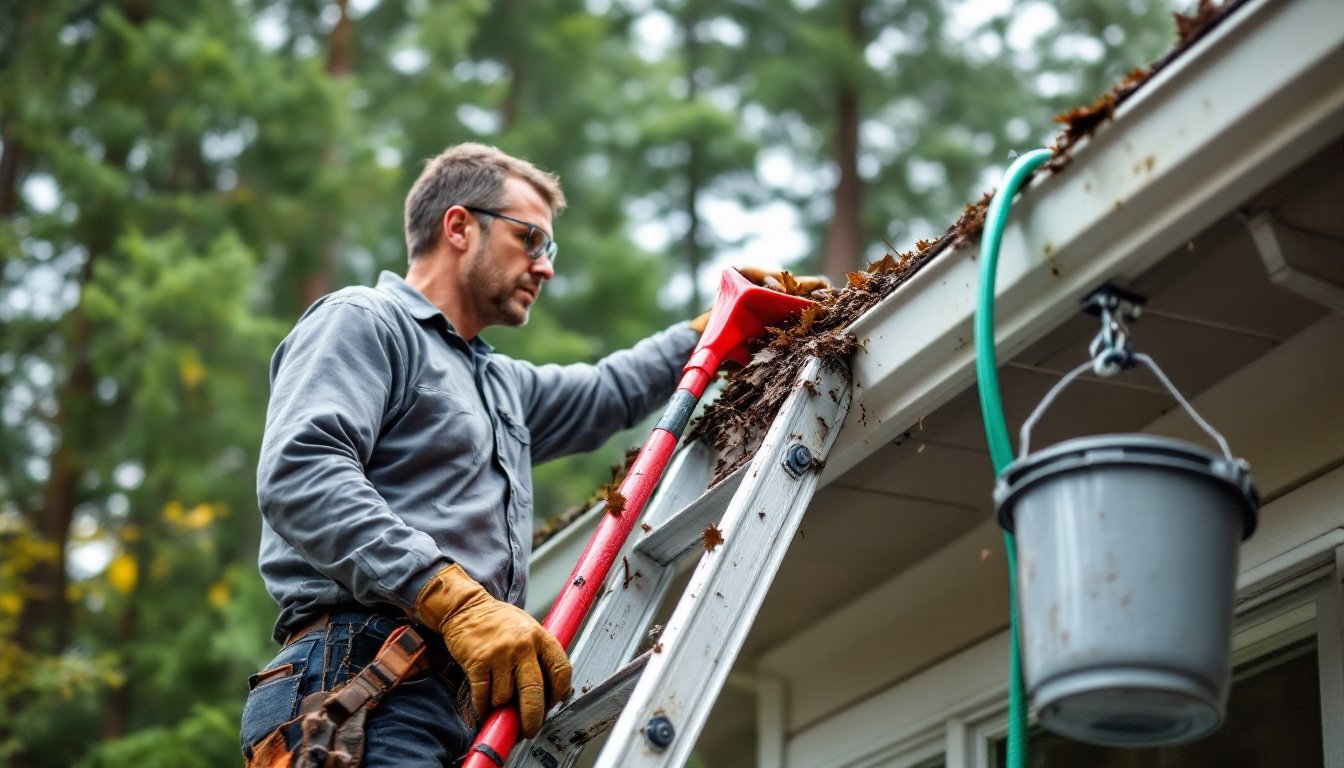
• Extension ladder: Minimum Type II (225 lb. capacity). A 24-foot ladder handles most single-story homes: two-story homes need 28–32 feet. Fiberglass ladders are heavier but won’t conduct electricity if you contact a service line.
• Gutter scoop or trowel: A plastic gutter scoop (about $5) fits the gutter profile better than a garden trowel and won’t scratch aluminum.
• 5-gallon bucket with a hook: Clip it to the ladder so you’re not climbing up and down for every handful of muck.
• Garden hose with a spray nozzle: For flushing downspouts. A pressure washer is overkill and can damage gutter seams.
• Work gloves: Leather or heavy synthetic. Gutter sludge contains decomposed organic matter, animal droppings, and sometimes sharp metal edges or roofing nails.
• Safety glasses: Mandatory. Debris and insects get dislodged when you start digging.
Safety equipment:
• Ladder stabilizer (standoff): This attachment keeps the ladder off the gutter face and provides a wider, more stable stance. Roughly $40 and worth every penny.
• Non-slip shoes: Closed-toe with rubber soles. No sandals, no smooth-soled boots.
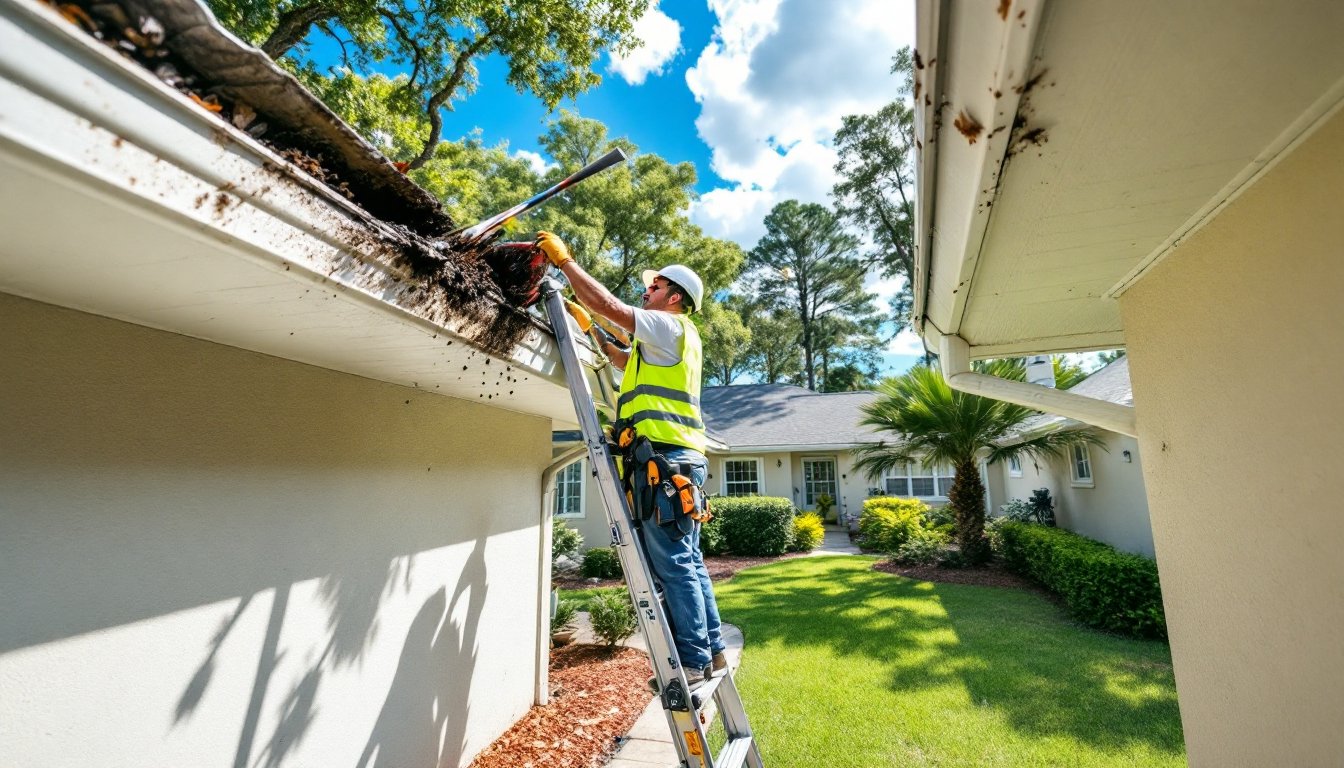
• Spotter: Especially for two-story homes or if you’re working near power lines. A second person steadies the ladder and can call for help if something goes wrong.
Avoid ladder work during high winds or within 24 hours of rain when roofs are slick. Central Florida’s afternoon thunderstorms are predictable, start early in the morning and wrap up by 1 PM.
How to Clean Your Gutters Safely and Effectively
Step-by-step process:
-
Set up the ladder on firm, level ground. Extend it so the top rests 3 feet above the gutter line (the 4-to-1 ratio: for every 4 feet of height, the base sits 1 foot out from the wall). Use the standoff to protect gutters and improve stability.
-
Start at the downspout. Scoop out large debris and drop it into the bucket. Work in 3–4 foot sections before repositioning the ladder. Never lean or overreach, move the ladder instead.
-
Check for gutter pitch. Gutters should slope 1/4 inch per 10 feet toward downspouts. If you see standing water after scooping, the hangers may have loosened. Tighten or add hangers every 24 inches to restore proper pitch.
-
Flush with the garden hose. Starting at the end opposite the downspout, rinse debris toward the outlet. If water backs up, the downspout is clogged.
-
Clear downspout blockages. Disconnect the bottom elbow if accessible. Use a plumber’s snake or a high-pressure hose nozzle fed from the top. Stubborn clogs may require disassembly of the downspout sections, they’re held with sheet metal screws or pop rivets.
-
Inspect while you’re up there. Look for loose fasteners, separated seams, rust spots on steel gutters, or sagging sections. Small gaps can be sealed with gutter sealant (a polyurethane or silicone formulation rated for exterior use). Larger issues, like a 6-foot sagging run, mean it’s time to call a pro.
-
Test the system. Run the hose for 5–10 minutes and watch how water exits the downspouts. It should flow freely. Check around the foundation to confirm the discharge is directed at least 4–6 feet away from the house.
Common mistakes to avoid:
• Using a pressure washer. It can separate seams and blow out caulk joints.
• Ignoring elbows and hidden sections. Downspouts have multiple turns where clogs hide.
• Cleaning only from the ground with a blower attachment. This pushes debris into downspouts and creates worse blockages.
For single-story ranch homes, this is a manageable afternoon project. Two-story homes with complex rooflines take longer and increase fall risk, consider whether the savings justify the hazard.
When to Hire a Professional Gutter Cleaning Service
DIY gutter cleaning isn’t always the right call. Some situations clearly favor hiring out the work.
Hire a pro if:
• Your home is two stories or taller. Falls from second-story heights cause serious injuries. Professional crews carry liability insurance and use stabilized ladder systems or bucket trucks.
• You have a steep-pitch roof (7/12 or greater). Accessing gutters on a steep roof requires roof anchors and harnesses. That’s specialized equipment most homeowners don’t own.
• You’re physically unable to climb or work overhead. No judgment, ladder work demands balance, grip strength, and stamina.
• Your gutters need repairs beyond cleaning. If you spot separated joints, damaged hangers, or fascia rot, a qualified contractor can clean and fix the system in one visit. Many gutter companies offer combination cleaning/repair service calls.
• Your schedule doesn’t allow it. Professionals handle an average single-story home in 1–2 hours. If your weekends are packed, the $120–$250 cost (typical range for Orlando single-story cleaning) buys back your time.
What to expect from a professional service:
Licensed services typically include debris removal, downspout flushing, and a basic inspection. Some offer minor repairs (tightening hangers, resealing joints) as part of the standard fee. Others charge separately for repairs. Homeowners seeking professionals in the area can compare ratings among top gutter cleaning pros before making a decision.
Ask about gutter guards during the service call. Products like mesh screens or foam inserts reduce cleaning frequency but don’t eliminate it. Pine needles and shingle granules still get through. Micro-mesh systems (stainless steel with a fine weave) perform better but cost $8–$15 per linear foot installed. Weigh that against your annual cleaning costs.
For cost planning, resources like HomeAdvisor can help estimate project expenses based on local market rates. Remember that prices fluctuate with season, expect higher quotes right before hurricane season when demand spikes.
Conclusion
Orlando’s climate doesn’t give gutters a break. Between relentless rainfall, dense tree cover, and the occasional hurricane, routine cleaning isn’t optional, it’s structural maintenance. Homeowners comfortable with ladders and basic tools can handle this themselves with the right safety precautions. Those with tall homes, physical limitations, or time constraints will find professional services deliver solid value. Either way, staying ahead of clogs protects the foundation, roof, and landscaping investments that define a Florida home.