Augusta’s humid subtropical climate brings heavy rainfall, towering pines, and an almost endless supply of oak leaves, all of which end up in your gutters. Clogged gutters aren’t just an eyesore: they’re a fast track to foundation damage, roof leaks, and wood rot. Yet most homeowners wait until water’s pouring over the sides before they grab a ladder. This guide walks through why gutter maintenance matters in Augusta’s specific conditions, how often locals should tackle the job, what it takes to DIY safely, and when it’s smarter to call in a pro. Whether you’re comfortable on a ladder or prefer to hire out, you’ll know exactly what needs doing and why.
Table of Contents
ToggleKey Takeaways
- Gutter cleaning in Augusta is essential to prevent foundation damage, roof leaks, and wood rot caused by the region’s heavy rainfall averaging 45 inches annually and continuous debris from pines and oak trees.
- Augusta’s climate requires quarterly gutter cleanings for tree-heavy properties instead of the standard twice-yearly schedule, especially after major storms that can overwhelm partially blocked systems.
- DIY gutter cleaning requires proper equipment, safety precautions, and technique, but hiring a professional gutter cleaning service in Augusta is recommended for multi-story homes or steep roofs to avoid falls.
- Professional gutter cleaning services in Augusta cost $100–$250 for single-story homes and $250–$400 for two-story properties, often including inspection and minor repairs.
- Proactive maintenance such as trimming overhanging branches, checking downspout extensions, and installing gutter guards can reduce cleaning frequency and prevent costly water damage.
- Spring pollen sludge and pine needle accumulation require seasonal flushing and inspection to maintain proper drainage and catch early signs of damage before problems become expensive.
Why Gutter Cleaning Is Essential for Augusta Homeowners
Gutters exist for one reason: to move water away from your foundation, siding, and roof edge. When leaves, pine needles, and organic debris clog them, water backs up under shingles, spills over fascia boards, and pools around your foundation. In Augusta, where annual rainfall averages around 45 inches and summer storms can dump several inches in an afternoon, a clogged gutter system can cause serious damage quickly.
Neglected gutters lead to fascia rot, basement seepage, and even cracked foundation slabs as water undermines the soil. Mosquitoes love standing water in clogged troughs, and mold thrives in the damp wood behind overflowing gutters. If your home has a crawl space, common in older Augusta neighborhoods, standing water from gutter overflow can encourage wood-boring insects and compromise floor joists. It’s not dramatic to say that gutters are your home’s first line of defense against water intrusion.
Augusta’s Climate and Its Impact on Your Gutters
Augusta sits in USDA Hardiness Zone 8a, with mild winters and long, humid summers. The area’s mix of longleaf pines, water oaks, and sweetgums means year-round debris. Pine needles fall almost continuously, and oak leaves drop heavily in late fall and again in spring during pollen season. That yellow-green coating on your car in March? It’s in your gutters too, forming a sticky paste when wet.
Summer thunderstorms are intense but localized, often delivering an inch or more of rain in under an hour. If your gutters are even partially blocked, that volume overwhelms the system. Winter freezes are rare but possible, and ice dams can form when trapped water refreezes overnight. Spring pollen clogs downspouts, and fall leaf drop can fill a 5-inch K-style gutter in days if you’ve got mature oaks overhead. Bottom line: Augusta’s climate doesn’t give gutters a break.
How Often Should You Clean Gutters in Augusta?
A general rule is twice a year, once in late fall after leaves drop, and again in late spring after pollen season. But in Augusta, that schedule might not be enough. Homes surrounded by pines or oaks often need quarterly cleanings, especially if branches overhang the roofline.
Inspect your gutters after major storms. Even if you cleaned them a month ago, a severe thunderstorm can blow debris into the troughs or knock loose shingle granules that clog downspouts. If you notice water spilling over the edges during a rain, don’t wait, get up there or call someone.
For homes with gutter guards (mesh screens, foam inserts, or surface-tension covers), you’ll still need occasional cleaning. Guards reduce debris volume but don’t eliminate it. Pine needles slip through mesh, and organic matter breaks down into sludge that blocks flow. Expect to clean guarded gutters once a year minimum, more if you’ve got heavy tree cover. Guards are helpful, but they’re not a replacement for maintenance.
DIY Gutter Cleaning: Tools and Step-by-Step Instructions
Cleaning gutters yourself saves money, but it’s not risk-free. You’re working at height, often on a wet surface, and dealing with decomposing organic matter. If you’re uncomfortable on a ladder or your home is taller than one story, skip to the next section.
Tools and materials you’ll need:
- Extension ladder rated for your weight plus 50 lbs (Type I or IA)
- Work gloves (nitrile-coated or heavy leather)
- Safety glasses (debris will fall back at you)
- Gutter scoop or plastic trowel
- 5-gallon bucket with a ladder hook or rope
- Garden hose with a spray nozzle
- Downspout auger or plumber’s snake (if downspouts clog)
Step-by-step process:
-
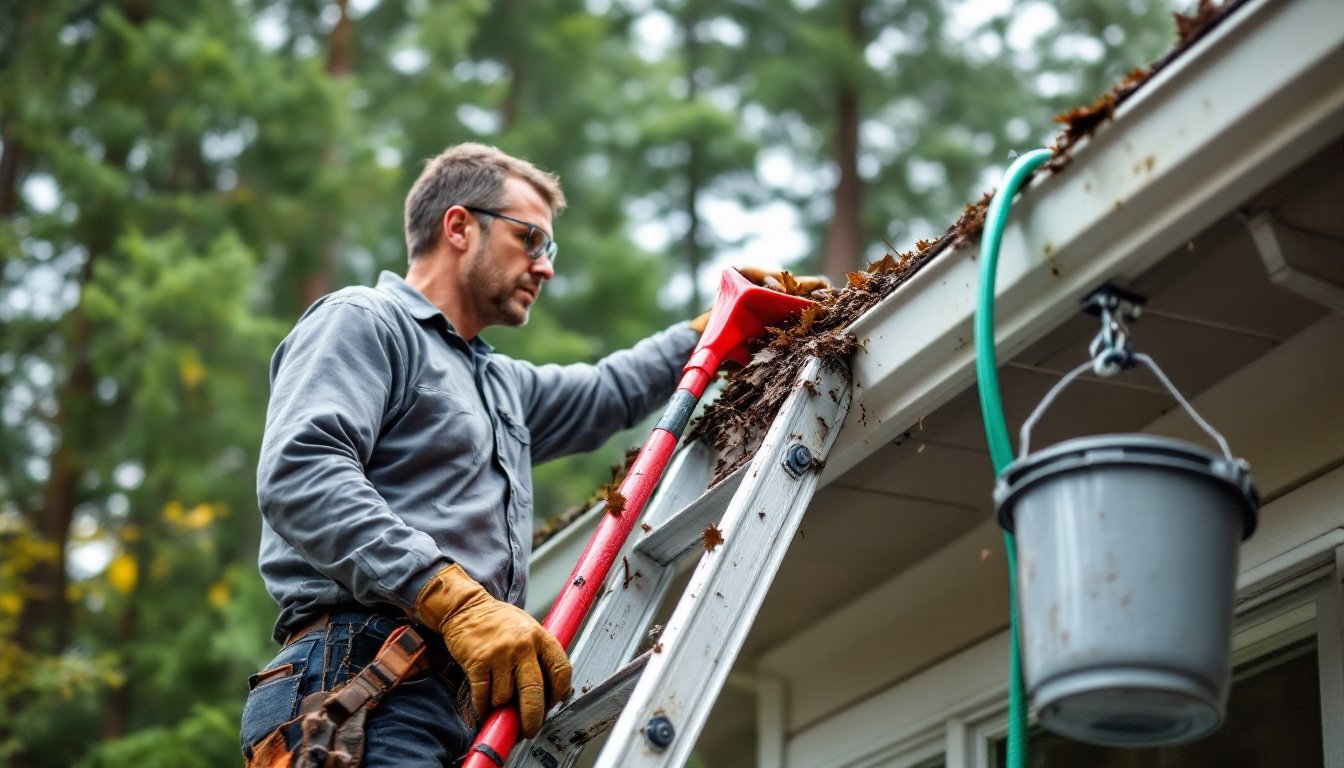
Set up your ladder safely. Place it on level ground, lean it at a 75-degree angle (the base should be one foot out for every four feet up), and have someone stabilize it if possible. Never lean an extension ladder against the gutter itself, it’ll bend the trough. Use a ladder standoff if you have one.
-
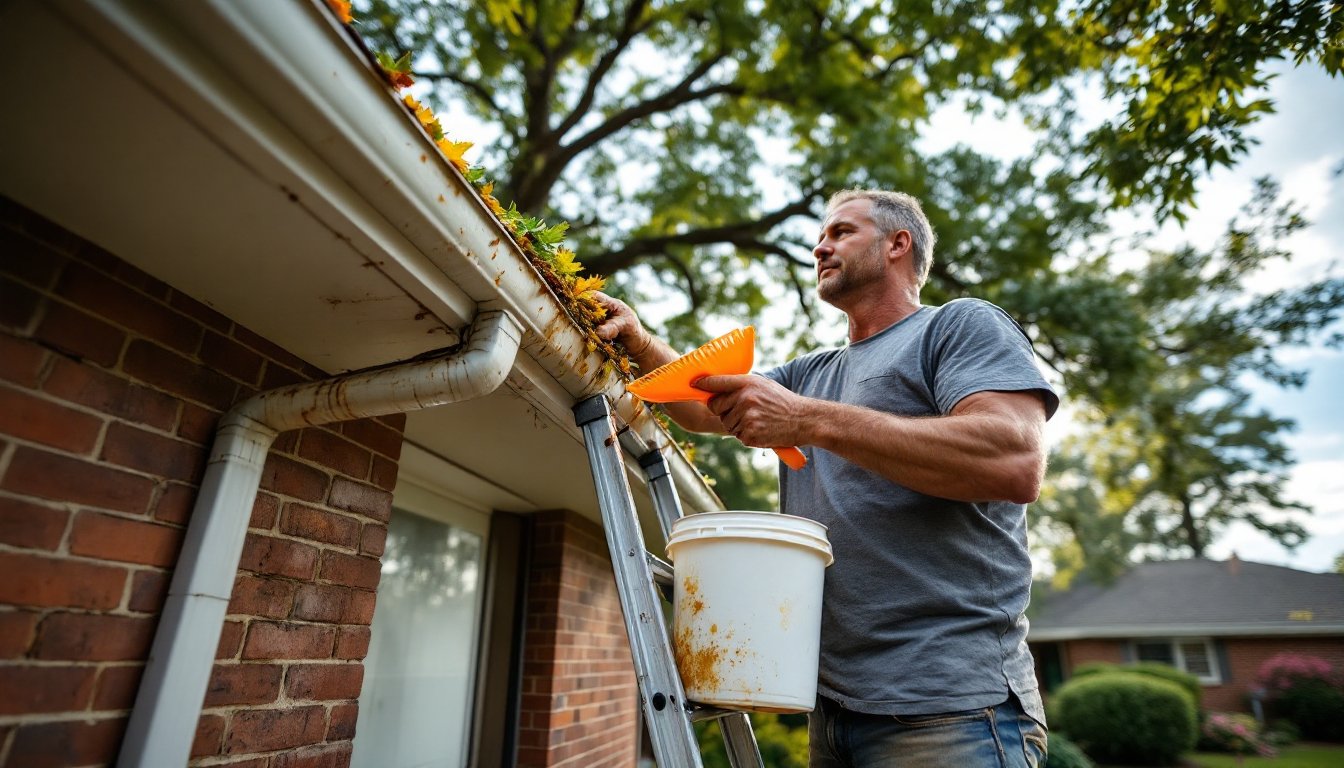
Scoop out debris. Start near a downspout and work away from it. Use your scoop or gloved hands to pull out leaves, pine needles, and sludge. Drop debris into the bucket or onto a tarp below. Don’t toss it, you’ll be cleaning your flowerbeds for days.
-
Flush with water. Once a section is clear, spray it down with the hose to push remaining debris toward the downspout. Watch for leaks at seams or joints, this is a good time to spot problems.
-
Clear downspouts. If water isn’t draining, the downspout’s clogged. Tap the outside to locate the blockage, then use a downspout auger or snake to break it up. You can also try flushing from the bottom up with a hose, but be ready, standing water will dump on you when the clog clears.
-
Inspect for damage. While you’re up there, check for sagging sections, loose hangers, or rust spots. Gutters should slope about 1/4 inch per 10 feet toward downspouts. If water’s pooling, rehang the section.
Safety notes: Wear your safety glasses, decomposing leaves harbor mold and bacteria. If you’re using a pressure washer attachment, be aware that high-pressure water can bend aluminum gutters or knock them off hangers. A standard garden hose is usually sufficient. And never, ever stand on the top two rungs of a ladder.
When to Hire a Professional Gutter Cleaning Service in Augusta
Hire a pro if your home is two stories or taller, if the roof pitch is steep, or if you don’t own a sturdy extension ladder. Gutter-related falls send thousands of homeowners to the ER every year, it’s not worth the risk if you’re not equipped or confident.
Professionals also bring tools most homeowners don’t have: truck-mounted vacuums, high-reach blower systems, and inspection cameras for downspouts. They’ll spot problems you’d miss, like hidden rot behind fascia boards or improperly pitched sections. Many services include a post-cleaning hose test to verify drainage and will provide photos or video of problem areas.
If you’ve got gutter guards, a pro can assess whether they’re doing their job or just trapping debris on top. Some guards require specialized removal for cleaning, and improper reinstallation voids warranties. If you’re dealing with top-rated gutter cleaning professionals, they’ll be familiar with common Augusta issues, oak tannin stains, pine tar buildup, and the seasonal pollen sludge that clogs downspouts every spring.
What to Expect: Costs and Service Options in Augusta
Pricing for professional gutter cleaning in Augusta typically runs $100 to $250 for a single-story home with around 150 to 200 linear feet of gutter. Two-story homes or properties with complex rooflines and multiple downspouts can push that to $250 to $400. These are mid-2026 estimates and will vary based on access difficulty, gutter condition, and whether downspouts need augering.
Most companies offer flat-rate pricing after a quick measurement or quote by linear foot (usually $0.75 to $1.50 per foot). Some include minor repairs, resealing joints, replacing a few hangers, at no extra charge. Others will upsell gutter guard installation, which ranges from $3 to $10 per linear foot depending on the system.
Expect the job to take one to two hours for a standard home. Professionals should carry liability insurance and workers’ comp, ask for proof before hiring. Avoid anyone who quotes without seeing the property or can’t provide references. Seasonal demand spikes in October and November, so book early if you want service before the holiday rush. Many services offer maintenance plans with scheduled cleanings, which can save 10 to 15 percent over one-off appointments.
Preventing Future Gutter Problems: Maintenance Tips for Augusta Homes
Cleaning gutters is reactive. Maintenance is proactive. A few simple habits will extend the life of your system and reduce cleaning frequency.
Trim overhanging branches. Limbs within 6 feet of your roofline drop debris directly into gutters. Trim them back, especially oaks and pines. This also reduces the risk of storm damage, a fallen branch will do more than clog a downspout.
Inspect after every major storm. A quick visual check from the ground takes five minutes. Look for sagging sections, water overflow, or separated joints. Catching small problems early prevents expensive repairs.
Check downspout extensions. Water should discharge at least 4 to 6 feet from your foundation. If your extensions are missing, crushed, or disconnected, runoff will pool against the house. Flexible corrugated extensions work but kink easily, rigid PVC or aluminum is better.
Seal leaks promptly. Small leaks at seams or joints grow quickly. Clean the area, dry it thoroughly, and apply a butyl rubber gutter sealant (not silicone, which doesn’t hold up outdoors). For larger holes, use a patch kit with aluminum flashing and sealant.
Consider gutter guards if trees are a constant issue. No guard is perfect, but micro-mesh systems (like those from home improvement platforms that vet contractors) do a solid job blocking leaves while allowing water through. Budget $500 to $1,500 for a full install on an average home. Foam inserts are cheaper but trap pine needles and decompose over time.
Rehang sagging sections. Gutters should be supported every 24 to 30 inches with hangers or spikes. If a section sags, it’s usually because a hanger failed. Replace it with a hidden hanger (also called a strap hanger), which mounts to the fascia and hooks inside the gutter lip. They’re stronger than old-school spike-and-ferrule systems and won’t pull out as easily.
Flush your system seasonally. Even if gutters look clear, run a hose through them once a season to check flow and spot slow drains. This is especially useful in spring, when pollen residue can form a sticky coating that traps future debris. For detailed cost and planning guidance, resources like home renovation cost guides can help you budget for upgrades or repairs.